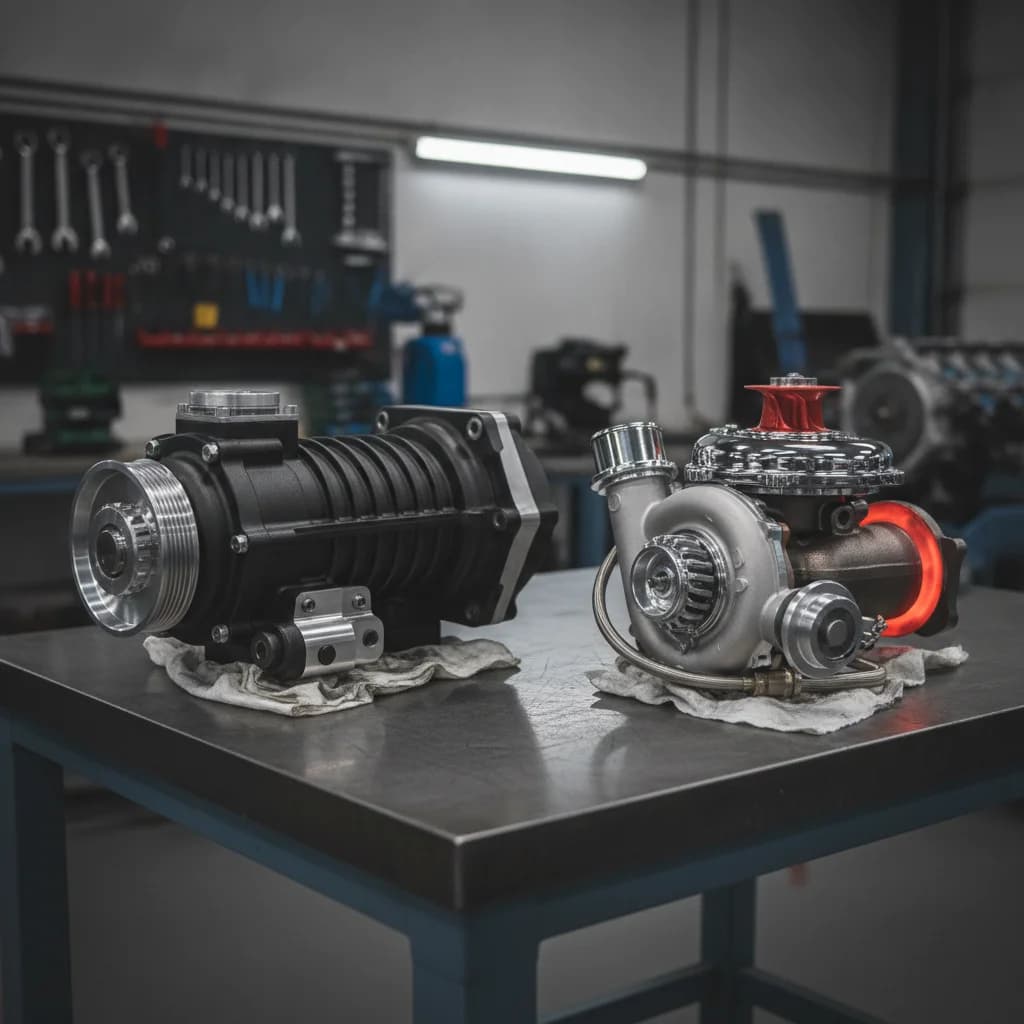
Choosing between a supercharger or a turbo depends on your performance goals. Superchargers deliver instant, linear power ideal for immediate throttle response and low-end torque, making them great for street driving and towing. Turbochargers use exhaust gas to create immense peak horsepower, excelling in high-power track and racing applications.
Table of contents
- How Do Superchargers and Turbochargers Actually Work?
- What Are the Differences in Power Delivery and Feel?
- Which is More Efficient: A Supercharger or a Turbo?
- Supercharger vs Turbo: How Do I Choose for My Driving Style?
- What Are the Installation and Maintenance Demands?
- Your Forced Induction Partner in Queen Creek, AZ
- Frequently Asked Questions
How Do Superchargers and Turbochargers Actually Work?
A supercharger is a belt-driven air compressor that forces more air into your engine. Because it's mechanically linked directly to the engine's crankshaft, its speed is proportional to engine RPM. This direct connection means it provides boost instantly, even at low engine speeds. There are three main types: Roots, twin-screw, and centrifugal. Roots and twin-screw are positive displacement blowers, moving a fixed volume of air per revolution, which results in a flat torque curve. A centrifugal supercharger functions like a belt-driven turbo, building boost exponentially with RPM.
A turbocharger uses your engine's exhaust gases to spin a turbine, which in turn spins a compressor wheel to force air into the engine. It is essentially a free-energy device, recycling waste energy from the exhaust stream. This process is not instantaneous; the engine must produce enough exhaust flow to spin the turbine to a high enough speed to create positive pressure (boost). The delay before the turbo produces significant boost is known as turbo lag.
What Are the Differences in Power Delivery and Feel?
The power delivery from a supercharger is immediate and linear, feeling like a much larger naturally aspirated engine. When you press the throttle, the response is instantaneous. This makes supercharged cars predictable and easy to drive, especially on a road course or for applications like towing where low-end torque is critical. A positive displacement supercharger provides a massive surge of torque right off idle.
Turbochargers deliver power differently. Below a certain RPM (the boost threshold), the car feels like a standard naturally aspirated vehicle. Once the engine speed rises and exhaust flow increases, the turbo spools up and delivers a dramatic surge of power that can feel explosive. Modern twin-scroll turbos and variable geometry designs have significantly reduced lag, but the fundamental characteristic of boost building with RPM remains. This rush of top-end power is what many drivers seek for drag racing or highway pulls.
Which is More Efficient: A Supercharger or a Turbo?
A turbocharger is fundamentally more efficient than a supercharger. Since it runs on waste exhaust gas energy, it doesn't sap mechanical power from the crankshaft to operate. This is in contrast to a supercharger, which creates parasitic loss—it can take 50 horsepower or more just to turn the supercharger at high boost levels. This parasitic drag means the engine has to work harder to produce the same net power, impacting overall fuel economy and efficiency.
However, efficiency isn't just about parasitic loss. It also involves thermal management. Turbochargers generate extreme heat because they are integrated with the exhaust system. This heat transfers to the intake air, reducing its density and increasing the risk of detonation. An efficient intercooler is not optional; it is a mandatory component of any turbo system. While superchargers also heat the intake air through compression, they do not introduce exhaust heat, making their thermal load easier to manage.
Definition: Volumetric Efficiency (VE) Volumetric Efficiency is a measure of how effectively an engine fills its cylinders with the air-fuel mixture. A naturally aspirated engine is typically limited to around 80-90% VE. Forced induction—whether from a supercharger or turbo—pushes the VE well over 100%, forcing more air molecules into the same cylinder volume, which is the entire basis for making more power.
Supercharger vs Turbo: How Do I Choose for My Driving Style?
Your choice depends on how you use your vehicle. There is no single best answer, only the best solution for your specific goals. A proper performance tuning plan begins with identifying the primary application and desired power characteristics before selecting hardware. We use data from our dyno and real-world testing to recommend the optimal path for each build.
Here is a breakdown to help guide your decision:
| Feature | Supercharger | Turbocharger |
|---|---|---|
| Power Delivery | Instant, linear, predictable boost from low RPM. | Delayed boost (lag), followed by a strong surge of power at mid-to-high RPM. |
| Best Use Case | Daily driving, road racing, autocross, towing, muscle cars. | Drag racing, highway pulls, high-horsepower builds, fuel-efficient power. |
| Engine Feel | Feels like a larger displacement, naturally aspirated engine. | Feels like two engines in one: mild off-boost, aggressive on-boost. |
| Installation | Generally simpler, often available in bolt-on kits. | More complex, requires custom exhaust manifolds, plumbing, and oil lines. |
| Efficiency | Less efficient due to parasitic drag from the crankshaft. | More efficient, as it uses waste exhaust energy. |
| Sound | Distinctive high-pitched whine. | Muffled exhaust note, accompanied by a whistle and blow-off valve sounds. |
| Heat Management | Lower heat load, simpler intercooling requirements. | High exhaust heat requires robust intercooling and thermal management. |
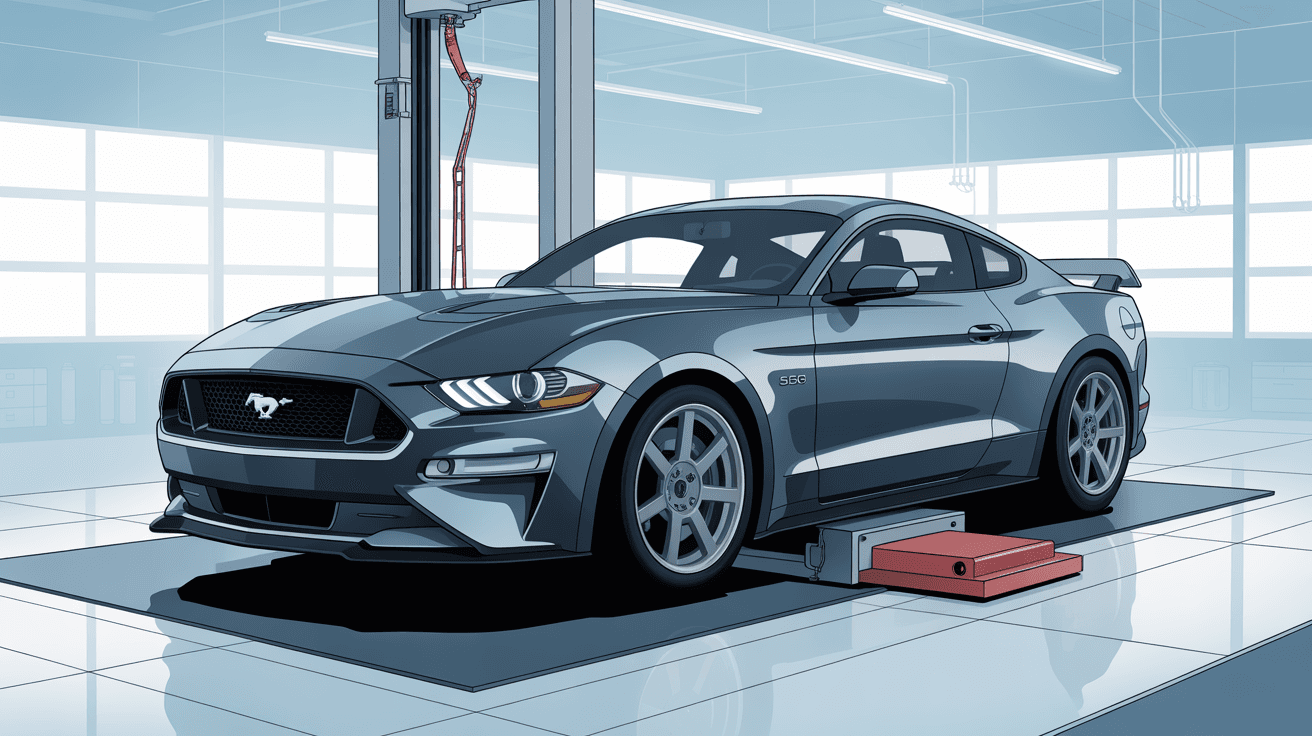
For a vehicle like a Ford Mustang, a supercharger enhances its V8 muscle-car character with instant torque, which is why many of our Mustang performance packages are built around them. For a build focused on maximum peak power for events like roll racing, a custom turbo system might be the superior choice.
What Are the Installation and Maintenance Demands?
Supercharger installations are typically more straightforward. Many are sold as comprehensive, bolt-on kits engineered for a specific vehicle, including the blower, intake manifold, fuel system upgrades, and a base ECU tune. Because they are self-contained and don't tap into the exhaust or oil systems, the installation process is less invasive.
Turbocharger systems are almost always more complex to install. They require custom exhaust manifolds or headers, a "downpipe" to connect the turbine outlet back to the exhaust, and plumbing for oil and coolant lines to lubricate and cool the turbo's center cartridge. The packaging is often tighter, demanding more fabrication and modification to surrounding components.
Maintenance for both systems involves regular oil changes and inspection of all plumbing and belts. Supercharger belts are a wear item and require periodic replacement. Turbochargers, with their extreme rotational speeds (often exceeding 150,000 RPM) and high temperatures, are sensitive to oil quality and supply. Oil starvation or contamination can destroy a turbo almost instantly.
Regardless of your choice, a forced induction system puts more stress on the entire powertrain. Your fuel system, cooling system, and internal engine components must be up to the task. Often, a camshaft upgrade designed for boost is recommended to optimize airflow and maximize the gains from your new power adder.
Your Forced Induction Partner in Queen Creek, AZ
The supercharger vs. turbo debate ultimately comes down to your personal goals. If you crave the instant, predictable throttle response of a larger engine for street driving or road racing, a supercharger is likely your answer. If your build is focused on maximum peak horsepower and you love the exhilarating rush of a turbo spooling up for highway pulls, a turbocharger is the path to take. Choosing the right form of forced induction is a significant decision, and the best choice is the one that aligns the hardware with your driving style and power goals.
At Apacustom Shop, we specialize in designing, installing, and dyno-tuning forced induction systems that deliver reliable, repeatable power. We don't just sell parts; we engineer complete, data-driven solutions. Our expert technicians will help you navigate the options and build a package that perfectly matches your vehicle and your vision.
Ready to add serious power to your build? Contact the Apacustom Shop team today to discuss your project and determine which form of boost is right for you. Our shop is located at 22375 S Scotland Ct Suite 105, Queen Creek, AZ 85142, and you can reach us at (602) 762-4916.
Frequently Asked Questions
Can I install both a supercharger and a turbocharger?
Yes, this is called twin-charging. This setup uses a supercharger for instant low-RPM response and a turbocharger for massive high-RPM power, effectively eliminating the major drawback of each system. However, twin-charging is exceptionally complex and expensive to install and tune correctly, making it rare outside of dedicated, high-level racing builds.
Does forced induction reduce engine life?
Forced induction adds stress to engine components, but a properly designed and tuned system on a healthy engine does not inherently reduce its lifespan. Longevity depends on the quality of the components, the precision of the ECU tune, diligent maintenance, and responsible driving. Pushing an engine beyond the limits of its stock internal components is what causes premature failure.
What supporting mods are necessary for a supercharger or turbo?
At a minimum, you will need a higher-capacity fuel pump, larger fuel injectors, and a custom ECU tune. A high-efficiency intercooler is mandatory for managing intake air temperatures. Depending on the boost level, you may also need a stronger clutch, upgraded cooling system, and forged internal components like pistons and connecting rods.
How much horsepower can a supercharger or turbo add?
A mild bolt-on system on an otherwise stock V8 can add 150-200 horsepower. Highly modified builds with forged internals, E85 fuel, and aggressive boost levels can see gains of 500 horsepower or more over stock. The final output depends on the engine platform, the size of the supercharger or turbo, the boost level, and the quality of the supporting components and tune.
What is "boost lag" and can it be eliminated?
Boost lag is the delay between pressing the throttle and the turbocharger spinning up to produce significant boost. It's caused by the time it takes for exhaust gases to build enough energy to accelerate the turbine. Modern technology like twin-scroll turbines, ball-bearing cartridges, and smaller, quick-spooling turbos have dramatically reduced lag, but it cannot be completely eliminated as it is inherent to the exhaust-driven design.
Is a supercharger or turbo better for a daily driver?
For most daily drivers, a supercharger is often the better choice. Its instant, linear power delivery is more usable and predictable in typical city and highway driving. The immediate throttle response makes the car feel powerful and responsive at any speed without the sudden power surge of a turbo, which can be less desirable in traffic or poor weather conditions.