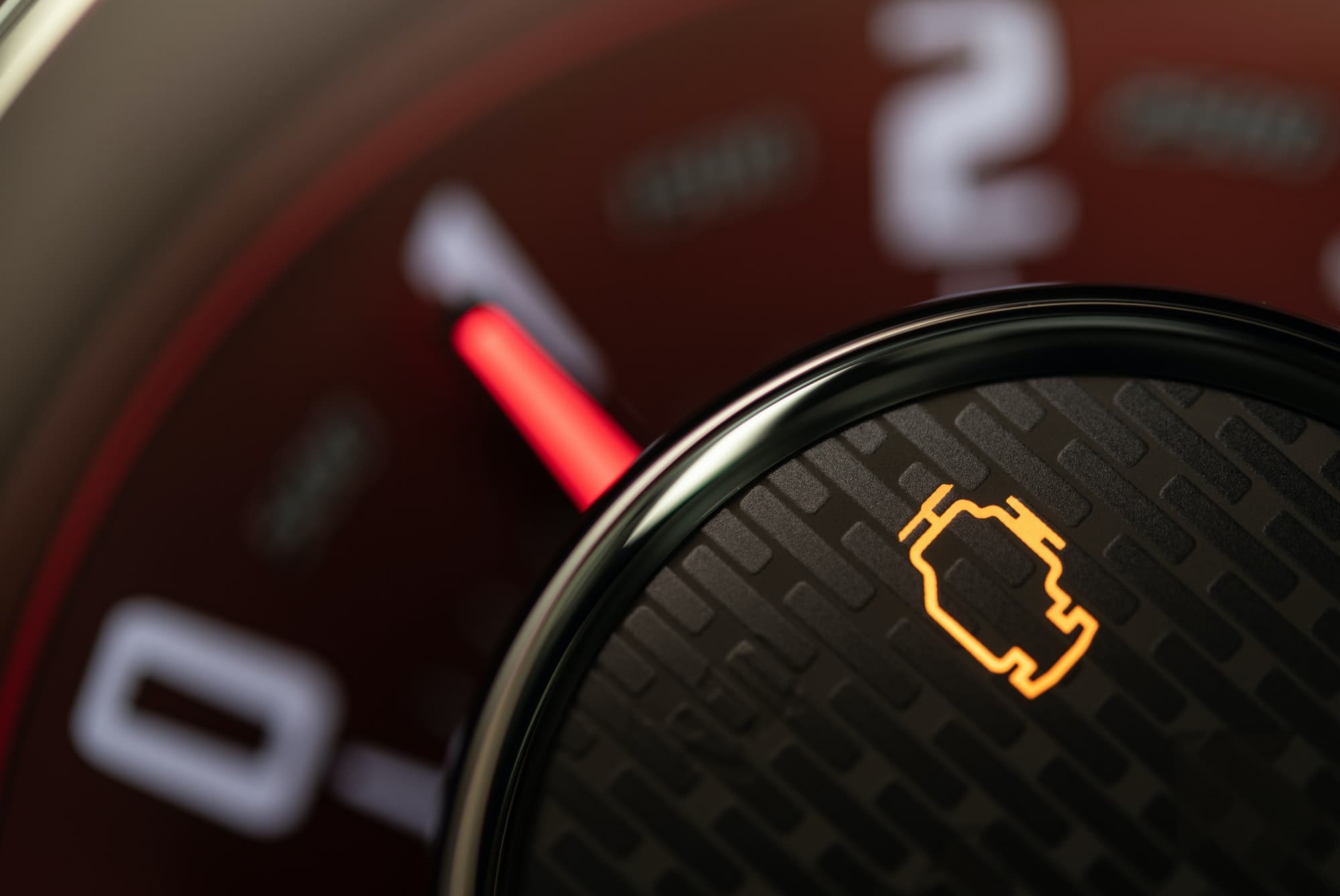
Few dashboard lights cause as much anxiety (and get ignored as often) as the Check Engine light. The good news: it's not random. Your car's onboard diagnostics system turned it on because it detected something specific, and it stored a code that tells a technician exactly where to look. The bad news: “it's probably nothing” is how small problems become expensive ones.
What the light actually means
Since the mid-1990s, every car sold in the U.S. has an OBD-II system that constantly monitors the engine and emissions components. When a sensor reads outside its expected range, the computer sets a Diagnostic Trouble Code (DTC) and illuminates the Check Engine light. That code is the starting point for a real diagnosis: not the whole answer, but the map.
Solid light vs. flashing light
This distinction matters more than any other:
- Solid Check Engine light: A fault the system wants addressed. The car is usually safe to drive short-term, but get it diagnosed soon.
- Flashing Check Engine light: An active, severe misfire that can dump raw fuel into the exhaust and destroy the catalytic converter in minutes. Ease off the throttle and get it looked at right away.
The most common causes
A huge share of Check Engine lights trace back to a handful of culprits:
- A loose or failed gas cap (yes, really: it breaks the evaporative-emissions seal)
- A failing oxygen (O2) sensor
- A bad mass airflow (MAF) sensor
- Worn spark plugs or ignition coils causing a misfire
- A failing catalytic converter (often the downstream symptom of an ignored problem)
The cheapest repair is almost always the one you catch early. A $40 sensor ignored long enough can take a $1,500 catalytic converter with it.
Why ignoring it costs more
The Check Engine light rarely gets better on its own. A small vacuum leak or a lazy sensor makes the engine run slightly rich or lean; over time that extra fuel and heat wear out the catalytic converter, foul the plugs, and hurt fuel economy. What could have been a quick fix becomes a chain of related failures. On a performance engine, an ignored misfire or lean condition is even less forgiving.
What to do when it comes on
First, check that your gas cap is tight: it's free and it's a common trigger. If the light stays on, get the codes read and, more importantly, get them interpreted. A code points to a system, not a specific broken part; proper diagnosis means testing the components in that system to find the actual fault. That's where advanced car diagnostics pay for themselves: you fix the problem once instead of throwing parts at it.
If your light is on, solid or flashing, we can pull the codes and run a full diagnostic workup at our Queen Creek shop to tell you exactly what's going on before it turns into something bigger. Book a diagnostic or call (602) 762-4916.